


Documentary Series · 16 Episodes
The Dr. Walther Grot Documentary
The life and career of the chemist who found the applications for Nafion — nearly forty years at DuPont, a discovery that reshaped the chlor-alkali industry, and the spark of curiosity that started it all. Told in his own words.
Introduction: The Dr. Walther Grot Documentary
The Series

Episode One: Nafion™ – How It Came To Be

Episode Two: How Did Walther's Interest in Chemistry Begin?
Episode Three: Learning Chemistry During WW2
Episode Four: Earning a PhD Under Hans Meerwein

Episode Five: A DuPont Offer and the Move to America

Episode Six: First Impressions of America
Episode Seven: The Revolutionary Idea Behind Nafion™

Episode Eight: How Nafion™ Is Made
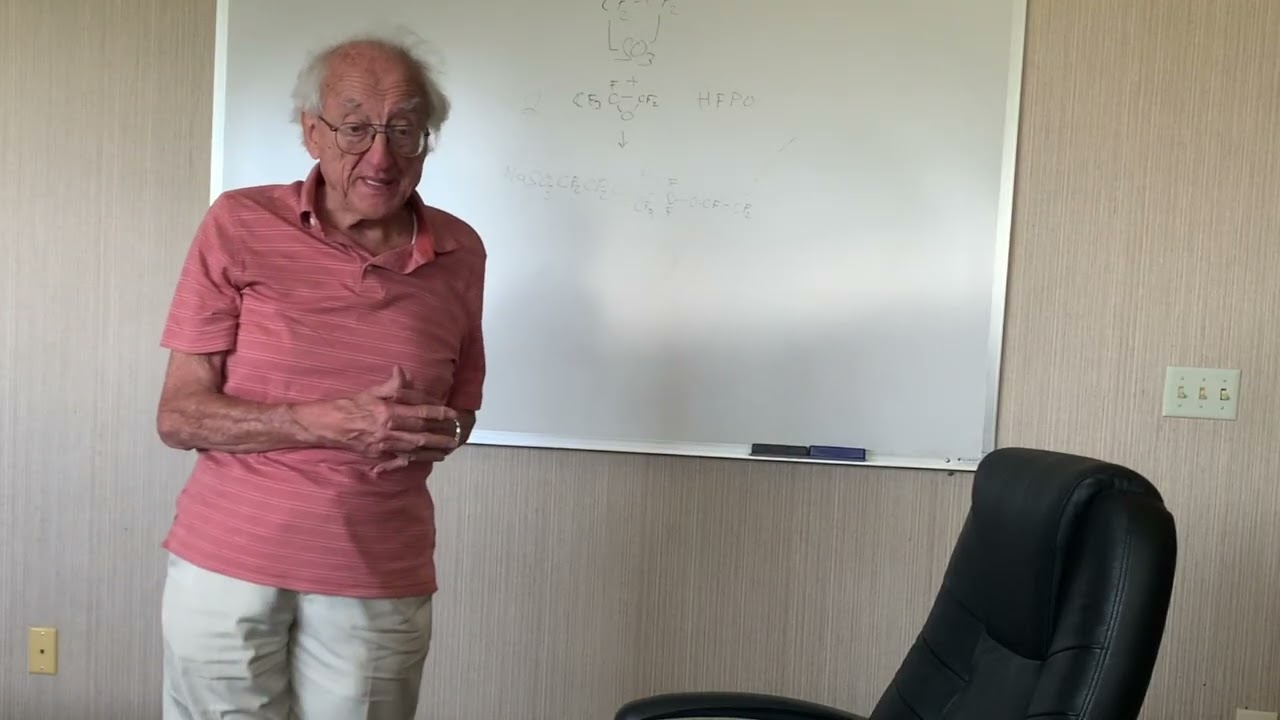
Episode Nine: What Is an Ion?
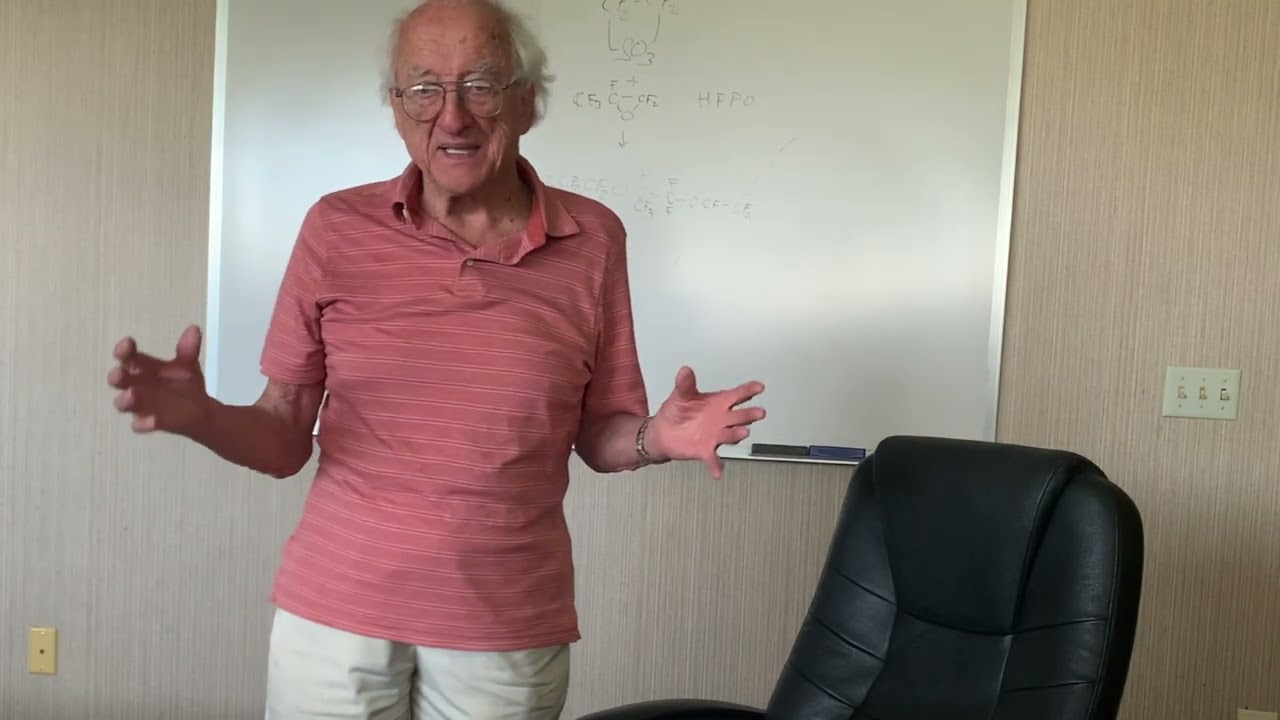
Episode Ten: Betting on Electrochemistry

Episode Eleven: Replacing Mercury in the Chlor-Alkali Industry
Follow the whole story
New episodes drop every Sunday. Subscribe on YouTube so you don't miss one.
Subscribe on YouTubeIntroduction: The Dr. Walther Grot Documentary
In this opening episode, Dr. Stephen Grot — president of Ion Power and son of Dr. Walther Grot — introduces a documentary six years in the making. Standing in Ion Power's original headquarters in New Castle, Delaware, he sets the stage for the life story of the man many in the industry knew as the father of Nafion.
Dr. Walther Grot passed away on March 11, 2026. About six years earlier, Stephen and his son Wilhelm sat down with Walther to record a series of conversations, preserving his story in his own words. The result is a sixteen-part series tracing Walther's nearly forty-year career at DuPont — the invention of a groundbreaking new material, the patent fights and marketing work that carried it from the lab to the market, and its eventual role transforming the chlor-alkali industry.
More than a company history, the series is a portrait of scientific curiosity. It starts with a spark most people would overlook: a chemistry set handed to a ten-year-old boy in 1930s Berlin. Stephen hopes the episodes resonate with anyone working in a STEM field — a reminder of how far a single early interest can carry a person over a lifetime.
He closes the introduction with a story that captured everything his father had achieved. In the early 2000s, Stephen and his wife Wendy had just launched their own business and were working the trade-show circuit, where a Japanese business consultant they knew as Kato-san turned to a restless group of colleagues and said something in Japanese — and suddenly everyone wanted a photo with Walther. That was the moment it clicked: his father's work had genuinely reached an entire industry on the other side of the world. You can also read Ion Power's tribute to Dr. Grot here.
Nafion™: How It Came To Be
Sitting down with his father at Ion Power, Dr. Stephen Grot asks the question at the heart of the whole series: how did Nafion come to be? Dr. Walther Grot — widely credited as its inventor — answers with a characteristic bit of humility.
The original concept, Walther explains, didn't come from him. It came from the manager of DuPont's exploratory research group, Frank Gresham. The idea was elegant: take a Teflon derivative and attach an ionic group to it, turning an inert fluoropolymer into an ionic conductor. A colleague, Donald Connolly, was assigned to actually make the material — and within a few months, he had synthesized the polymer.
When Connolly moved over to marketing, the next challenge landed on Walther's desk: figuring out what this brand-new material was actually good for. Finding applications for Nafion became his job — and it's the work that would define the decades that followed. By his account, that was 1963: the true starting point for Nafion.
It's a fitting introduction to Walther's style — precise about the facts, generous with credit, and quietly proud of a discovery that would go on to reshape entire industries.
How Did Walther's Interest in Chemistry Begin?
Every career has an origin story. Dr. Walther Grot's began under a Christmas tree in Berlin — with a chemistry set and a very curious ten-year-old.
In this episode, Walther traces his lifelong fascination with chemistry back to a single gift. When he was ten, he received a Kosmos chemistry set for Christmas, and it changed everything. This was no toy, he's careful to point out — not "chemical magic," but real, scientific chemistry. He suspects a set like it wouldn't be sold today, given modern safety standards. Chemistry, after all, can be dangerous.
He has the proof on his left thumb: a scar from an experiment that went wrong when he was around twelve. What was the experiment? Walther won't say — he's genuinely worried someone might try to repeat it. The lesson he took away stuck with him for life: chemistry demands respect.
The setting was Berlin in 1939, shortly after the war had begun. The city was still relatively peaceful then — beyond the reach of the British bombers that would come later. Formal chemistry wasn't taught until the fourth year of high school, so young Walther was still too young to study it in a classroom. That did nothing to slow him down; if anything, it only sharpened his interest.
Learning Chemistry During WW2
By 1943, the air raids over Berlin had grown constant, and Walther's schooling — and his safety — turned on a single decision his mother made.
As the raids intensified, Berlin's schools closed and most of Walther's classmates were evacuated east, to a village in occupied Poland. His mother judged that heading east was the wrong direction. Instead, she arranged for him to stay with a farmer in a remote corner of southwestern Germany, well away from the fighting. It was a quiet place — in the suburbs where they had lived, he recalls, the raids were barely a problem; the real devastation fell on the inner cities, set ablaze by incendiary bombs.
The war still found its way into daily life. When a British bomber was shot down with its payload intact, the recovered incendiary bombs were handed out so people could practice putting them out — simple enough in an open field with a bag of sand, far trickier lodged in a building. After a raid, children combed the ground for souvenirs, collecting shrapnel from the flak. Walther's own brother, just sixteen, was posted to an anti-aircraft battery, helping work the guns.
Through all of it, his chemistry education was on hold. School offered little — the subject had lost the high regard it once held in Germany — so from 1943 until he finished high school in 1948, Walther taught himself. Looking back, he counts himself lucky in his timing: born in 1929, he was too young to be pulled into the Second World War, and later too old for any war he might have faced in America.
After the war, the family moved north into the British occupation zone, where he finally finished high school. From there he went on to university — first at Göttingen, then at Marburg — carrying the self-taught curiosity that had seen him through the war years.
Earning a PhD Under Hans Meerwein
With the war behind him and university underway, Walther set out to earn his doctorate — under one of the towering figures of classical organic chemistry.
He completed his PhD in 1955 at Marburg, working under Professor Hans Meerwein — and, by his own account, he was one of Meerwein's very last students. Meerwein belonged to the old school: a chemist whose name was already permanently attached to reactions he had discovered, among them the Wagner–Meerwein rearrangement and the Meerwein–Ponndorf–Verley reduction. To train under him was to learn the craft from a living piece of chemistry's history.
Walther's own thesis pointed somewhere far more obscure — the chemistry of diphenyliodonium salts, a narrow and specialized corner of organic chemistry. Did it lead to anything useful, his son asks? Not really, Walther admits with his usual candor; it was, as he puts it, pretty obscure chemistry. But the doctorate it earned him — and the rigor it demanded — would soon carry him across the Atlantic and into the work that made his name.
A DuPont Offer and the Move to America
Doctorate in hand, Walther made the decision that would define the rest of his life: he answered a job posting an ocean away.
Fresh from his PhD in organic chemistry, Walther sent an application to DuPont — drawn, simply, by the idea of seeing the United States. It led to an interview in Frankfurt with Ed Jefferson — Edward G. Jefferson, who three decades later would become DuPont's chairman and CEO — and a job offer on the spot. Walther calls it one of the lucky breaks of his life. The pay sealed it: $640 a month, nearly three times what a young chemist could expect in the German chemical industry, with the promise of interesting work besides. It was, he says, an easy decision.
Getting there was its own adventure. In the late 1950s most immigrants still crossed the Atlantic by boat, but Pan American Airways, angling for a share of that traffic, had just introduced a $200 one-way fare — two free suitcases included, to compete with the steamships. Walther took the plane: a propeller aircraft that stopped to refuel along the way, once in Ireland and again in Bangor, Maine, on a journey that stretched to some seventeen hours.
Not everyone wished him off kindly. Saying goodbye to his fellow students at the Chemical Institute, Walther was cornered by one of his professors, who heard the news and chewed him out on the spot — carrying on, to Walther's embarrassment, as though his leaving would do irreparable harm to the German chemical industry. Looking back, he sees it differently, and with a wink: his departure, he suspects, was actually a lucky day for German chemistry, which gained far more from his work at DuPont than it ever could have from whatever he would have done at home.
First Impressions of America
The propeller plane landed, and America introduced itself right away — at the information desk of a New York railroad station.
Walther needed a train to Wilmington for his first-day formalities at DuPont. When he asked a uniformed railroad man which track his train would leave from, the answer stunned him: no idea. Where could he find out? Nowhere — the track wouldn't be decided until maybe twenty minutes before departure. In Germany, he marveled, they know a year in advance; the posters are already printed and hanging in the station. He found his train in the end, but the welcome stuck with him — and it kicks off some good-natured father-and-son ribbing about American railroads that's worth the watch on its own.
His first assignment took him to DuPont's Belle Works near Charleston, West Virginia — an ammonia and methanol plant built on the state's coal deposits, complete with its own coke ovens and, as Walther puts it, a bit on the dirty side. The plant made adipic acid for nylon and methyl methacrylate for Plexiglas, and one of his first jobs was pure chemical detective work: identifying a mystery ammonium salt contaminating the fertilizer-grade ammonium sulfate that came off the process. He cracked it — the ammonium salt of acetone-1,3-disulfonic acid.
West Virginia itself won him over: scenery that reminded him of the Black Forest, where he had spent the last years of the war, and friendly, pleasant people. Then a departmental reorganization ended research at Belle and scattered its chemists across the company — and Walther, by his own account the lucky one, landed at the Experimental Station in Wilmington, Delaware, DuPont's main research facility, where he would spend the rest of his career. Doing research there, he says, was simply fun.
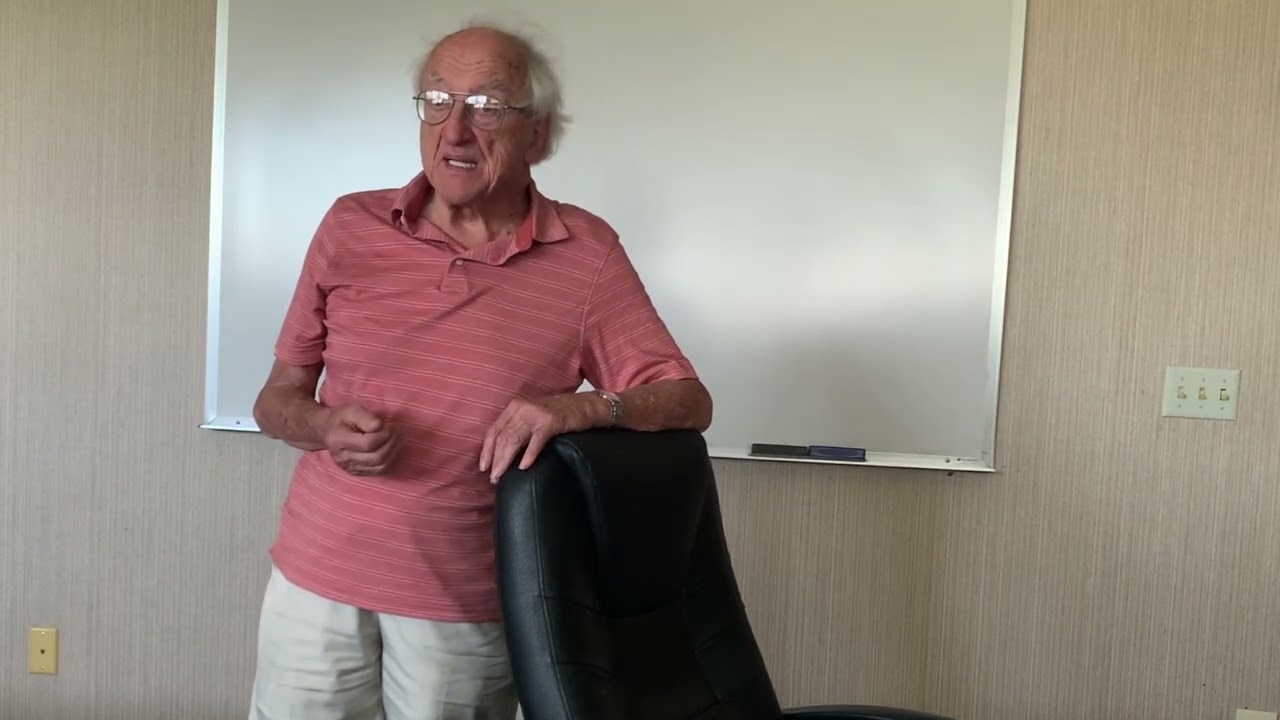
The Revolutionary Idea Behind Nafion™
Back to the invention itself — and to a research group whose entire job was to chase ideas nobody had tried before.
Frank Gresham — William Franklin Gresham — ran DuPont's exploratory chemistry group, a team pointed not at filling known needs but at a more open question: can we make something totally different from anything done before? His idea was a study in contradiction. Teflon was prized as an electrical insulator, the dielectric wrapped around wire and cable. Introduce an ionic group into it, and you open the door to electrical conductivity. Two completely opposite concepts, combined in a single polymer — something genuinely new. Revolutionary, in Walther's word.
The lab work went first to Walther's colleague Donald Connolly, who within a couple of months had made the first of the polymer — years before anyone called it Nafion. Connolly's and Gresham's names sit together on the foundational patent. And when Connolly was transferred to marketing, the assignment passed to Walther: turn this raw polymer into a product, and find out what it's good for. Much of the rest of the series is the story of that assignment.
How Nafion™ Is Made
Marker in hand, Walther steps up to the board for the episode chemists will love: how you actually make Nafion.
It starts with the same raw material as Teflon: tetrafluoroethylene, a small molecule with a double bond. Open that bond and it links into a chain — a chain reaction — and that's how Teflon is made. Nafion's route branches off early. First, tetrafluoroethylene is reacted with sulfur trioxide, opening the double bond to form a four-membered ring. That ring is then reacted with hexafluoropropylene oxide — HFPO for short — and two of those molecules build the special monomer behind Nafion.
That monomer carries a double bond of its own, so it can be polymerized together with tetrafluoroethylene: the backbone grows as a chain, with the new group hanging off the side. The result is the precursor polymer — not ionic yet, but one easy step away. React it with sodium hydroxide and you get the sodium salt of the sulfonic acid: an ionic conductor, built on a Teflon backbone.
What Is an Ion?
The company is called Ion Power — so, as Walther says at the board, he had better explain what an ion actually is.
Every atom carries electrons: hydrogen just one, lithium three. Let lithium give one up and it becomes a lithium ion — positively charged, and the working heart of the lithium-ion battery. Sodium behaves the same way in Nafion. It hands an electron to the polymer's sulfonic acid group and becomes a positive ion, held in place only loosely by electrical attraction — free to be swapped for other ions, or to move through the polymer as a crowd of charges. Moving ions are an electric current, which makes Nafion an ionic conductor: a fundamentally different animal from copper wire, which conducts by moving electrons.
And ionic conduction, Walther points out, is nothing new — nature has run on it for millions of years. Nerve signals are ionic currents. If the eye is a television camera, then the optic nerve is the cable carrying the picture to the brain — and there is not a strand of copper in it. It runs a touch slower than electrons (ions have mass; electrons essentially none), but it has worked reliably for as long as there have been eyes to see.
Betting on Electrochemistry
It's the mid-1960s. DuPont has a brand-new polymer that conducts ions. Now — what do you actually do with it?
The marketing group had ideas, but they were Teflon wire-insulation salesmen at heart. One suggestion: Teflon's famous non-stick surface won't hold printing ink — maybe the ionic polymer could fix that? Ideas like it came and went, and none of them stuck. Walther argued for something more fundamental: if the polymer's defining property is ionic conductivity, its natural home is electrochemistry — the field where electricity and chemicals meet.
Electrochemistry runs in both directions, and father and son each take a side. You can use electricity to make chemicals — Walther's instinct, as a chemist at a chemical company. Or you can use chemicals to make and store electricity — the view Stephen, trained as an electrical engineer, naturally takes. That second road leads to devices like the vanadium ion battery, a flow battery whose charge is stored not inside the cell but in tanks of liquid solution. Both roads, as the coming episodes show, run straight through Nafion.
Replacing Mercury in the Chlor-Alkali Industry
This is the episode where the polymer finds its purpose — by solving a mercury problem the chemical industry had lived with for eighty years.
Walther went looking at one of the largest industrial electrochemical reactions in the world: the chlor-alkali process, which splits ordinary salt into chlorine and caustic soda. Run current through brine and the chloride becomes chlorine gas while the sodium becomes sodium hydroxide — plus hydrogen, which must be kept well away from the chlorine, since together they form an explosive mixture. Everything hinges on the separator between them.
Two processes dominated. In the United States, plants used asbestos as the separator — a poor barrier that let nearly everything through: sodium ions, chloride ions, water, salt, leaving caustic soda of low concentration and low purity. The alternative came from Hamilton Castner, an American chemist who moved to England — then well ahead of America in chemistry — and patented the mercury cell in the 1890s. Technically it was brilliant: with mercury as the negative electrode, sodium forms a stable amalgam rather than hydroxide, and that amalgam can be carried out of the cell and decomposed elsewhere to yield caustic soda of high purity and concentration — no separator required inside the cell at all. (An Austrian chemist, Carl Kellner, hit on the same idea independently; rather than fight over it they partnered, which is why it's known as the Castner–Kellner process.)
Brilliant, but costly. Widely adopted across Europe and Japan, the mercury process leaked highly toxic mercury into the air and groundwater, and left traces in the caustic soda itself. Walther's proposal was to make the new polymer the separator: it would pass sodium ions through while blocking chloride and admitting only a little water — exactly the selectivity the cell needed, with no mercury anywhere in it. DuPont recognized the environmental advantage and pursued it hard. Turning raw polymer into a working commercial membrane took years — fabric reinforcement and a long list of other modifications — but it worked. The first major application came in Japan.